Game-Based Microlearning for Corporate Training with AI
If you’ve ever launched a “mandatory training” module and watched completion drag on for weeks, you’re not alone. Most workplace training fails for a simple reason: it asks busy people to stay focused for too long, with too little feedback.
Game-based microlearning flips that equation by delivering training in short, targeted bursts powered by game mechanics—points, streaks, quick challenges, instant feedback. It's a format employees are far more likely to actually finish and remember.
Better yet: with modern AI tools (like BrainFusion), HR and L&D teams can turn existing content (policies, SOPs, onboarding docs, slide decks) into game-based microlearning modules in minutes—without becoming instructional designers.
In this guide, you’ll get:
- A practical microlearning framework built for corporate constraints
- A step-by-step method to turn “boring training” into a quick game
- A mini-case example you can copy for your next module
- A simple rollout plan that works even if you’re a team of one
Why Microlearning Works in the Workplace
Microlearning is training delivered in small, focused units—each covering one objective. Research syntheses commonly describe microlearning as targeted, action-oriented, bite-sized content designed to achieve specific objectives in a short period of time (systematic review summary; peer-reviewed overview).
In practice, many corporate teams aim for “single-digit minutes.” A widely used industry heuristic is the 3–7 minute range—useful as a planning rule, even though the “perfect length” still depends on your topic and audience (Shift eLearning (industry guidance)).
That format maps better to how employees actually learn at work:
- Learning happens between meetings, on a commute, or during “in-between” time
- People need one actionable takeaway, not a full course
- The best training is easy to revisit later (reinforcement beats cramming)
There’s also growing evidence that microlearning can improve outcomes versus longer formats in many contexts. For example, an empirical study with a control-group design found microlearning was associated with higher learning performance than a comparison condition (open PDF study).
The catch: microlearning can still feel like “tiny boring training” if it’s just a slideshow split into smaller slides.
That’s where game-based design matters.
Why Game-Based Microlearning Boosts Engagement (Without Babysitting)
Game-based microlearning is not about turning compliance into an arcade. It’s about using proven engagement drivers:
- Immediate feedback (right/wrong now, not later)
- Progress visibility (levels, streaks, quick wins)
- Challenge loops (short attempts, retry-friendly)
- Social energy (optional friendly competition or team mode)
A major meta-analysis found gamification produces positive (small) effects on cognitive, motivational, and behavioral learning outcomes across studies (gamification meta-analysis). In workplace training specifically, reviews also emphasize that results depend on design quality and contextual fit—how well the mechanics match the job, culture, and learners (employee training gamification review; foundational gamification review).
This is especially valuable for training that employees typically resist:
- Compliance and policy refreshers
- Security awareness (phishing, passwords, devices)
- Onboarding knowledge checks
- Product training and internal enablement
- Customer service scripts and escalation paths
💡 Pro Tip: Design for “one behavior change”
The fastest way to upgrade training is to stop trying to teach everything at once. Pick one behavior (e.g., “Report suspicious emails”) and build a 5-minute game that reinforces it with scenarios and feedback.
The 5-Part Framework: Turning Training into Game-Based Microlearning
Here’s a repeatable framework you can apply to almost any corporate topic.
1) Choose one objective (not a chapter)
Bad objective: “Understand the entire Code of Conduct.”
Good objective: “Identify and report conflicts of interest.”
A micro-module should answer:
- What do you want someone to do differently tomorrow?
- What’s the most common mistake they make today?
2) Extract the “must-know” rules (3–5 bullets)
Pull only what’s essential:
- The rule
- The boundary
- The consequence
- The exception (if relevant)
3) Convert rules into decisions (scenarios > definitions)
Definitions don’t change behavior—decisions do.
Turn each rule into:
- A realistic situation
- 2–4 response options
- Immediate feedback explaining why
4) Add a short challenge loop
Examples:
- 8-question “Speed Round” (3 minutes)
- 5 scenarios + 1 “boss question”
- “Spot the mistake” lightning mode
- Retry mode for missed questions
5) Measure one signal and act on it
The point isn’t only completion—it’s improvement.
Track:
- Top missed questions
- Misconception patterns by team/role
- Repeat misses after 1 week
Then follow up with a second micro-module that targets the gap.
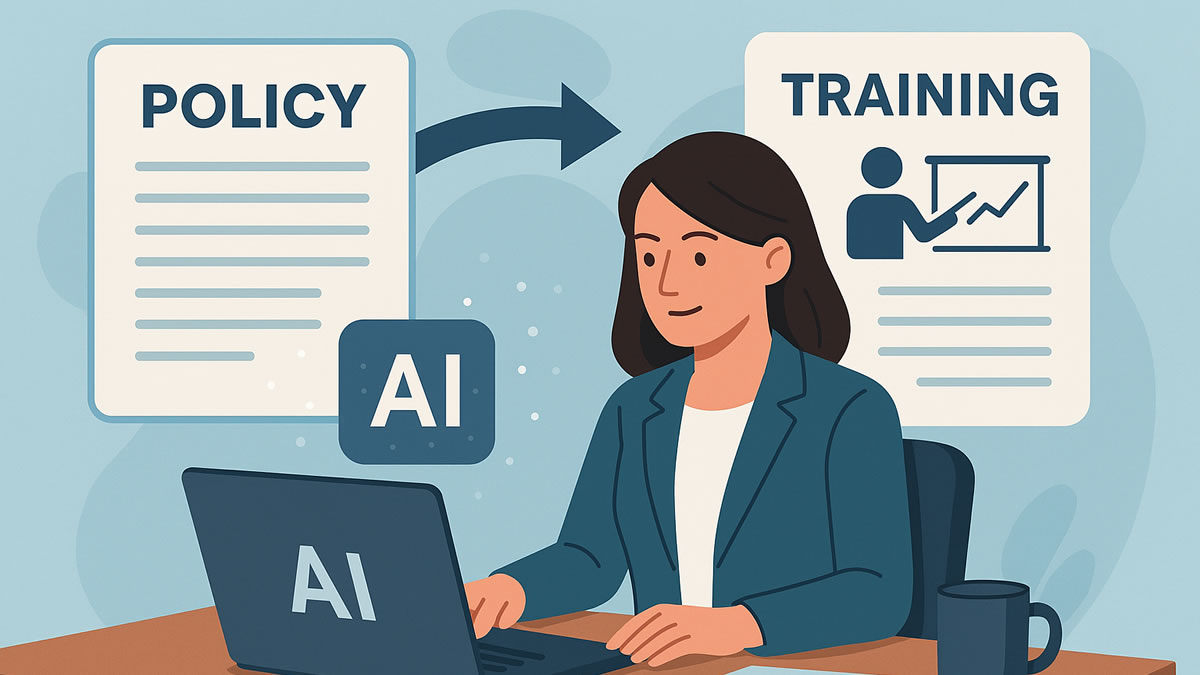
If you want a deeper look at how to turn existing policies into engaging training content, we've covered that separately—the framework above layers game mechanics on top of those same principles.
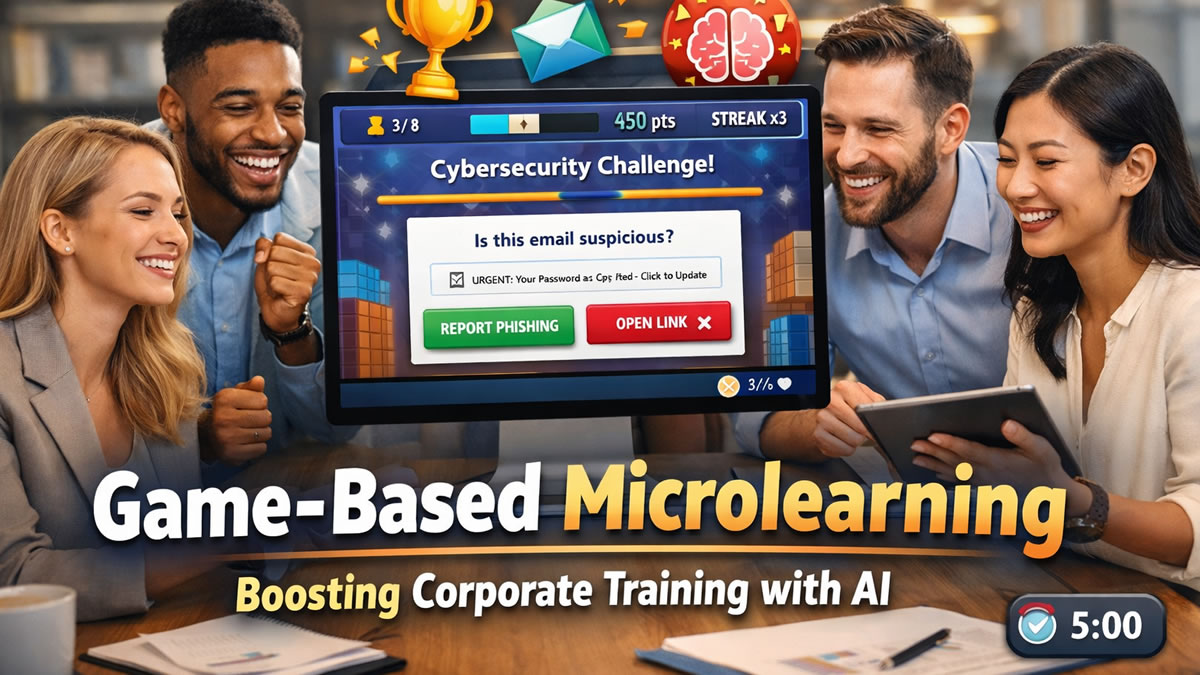
Step-by-Step Mini-Case: Make a Phishing Training People Actually Finish
Let’s take a classic: phishing awareness. Most companies already have a deck, a policy PDF, or a long LMS module.
Here’s how to turn it into a 5-minute game-based microlearning module.
Step 1: Pick your single objective
Objective: “Employees can identify suspicious emails and report them correctly.”
Step 2: Pull 4 “must-know” rules
- Check sender address and domain
- Be suspicious of urgency + unusual requests
- Don’t click unknown links or attachments
- Use the official reporting method (button/ticket)
Step 3: Write 6 scenario prompts (copy/paste ready)
- “Your CEO emails you: ‘Need gift cards ASAP—reply fast.’ What do you do?”
- “Invoice attached from a vendor you’ve never used. Attachment is .zip.”
- “Password reset link—‘expires in 10 minutes.’ Sender domain is slightly misspelled.”
- “Teams message: ‘Review this doc’ from a contractor you don’t recognize.”
- “HR ‘updated benefits’ PDF attached—sent at 2:13am.”
- “IT: ‘We need your MFA code to verify your device’—asks you to reply.”
For each prompt, offer 3–4 options:
- ✅ Report via the approved channel
- ✅ Verify through a known internal method
- ❌ Click / reply / forward / download
Step 4: Add feedback that teaches (not shames)
Example:
- “Correct—urgency + gift cards is a common social engineering pattern. Use the reporting button and do not reply.”
Step 5: Choose a game format + cadence
- Run it as a 5-minute live challenge in a team meeting
- Or assign it as a self-paced micro-module with a retry loop
- Follow up 7 days later with a second 3-minute “Spot the Red Flag” round
This approach also matches what workforce research explores: whether gamified e-training can improve information security self-efficacy and behaviors (workforce security training study).
Where AI Fits: From “We Don’t Have Time” to “Done in 10 Minutes”
Most L&D teams don’t struggle with ideas—they struggle with production time.
AI helps by compressing the build process:
- Convert existing documents into question sets
- Generate scenario-based multiple choice in your tone
- Produce variations for different roles (sales, ops, managers)
- Create multiple micro-modules from one source (onboarding + refresher + manager version)
With BrainFusion, the workflow looks like:
- Paste your policy / SOP / training notes
- Ask for a short “microlearning game” version (8–12 questions)
- Choose a game mode (live multiplayer or self-paced practice)
- Launch with a join code (no learner accounts)
- Review question-level analytics to see where people struggle
If you already have a slide deck or handbook, AI lets you get to a playable module fast—then your team can spend time where it matters: reviewing accuracy and tailoring scenarios to your workplace.
Try BrainFusion free — no credit card, no learner accounts required. For teams of 10+, view pricing options including enterprise licenses with bulk credits and dedicated support.
For more on using AI to streamline the content creation process, see our guide on using AI to build training from existing policies.
⚠️ Quick Warning: Don’t let AI invent policy details
AI is great at generating formats (questions, scenarios, feedback). It should NOT be the source of truth for your rules. If you’re using AI to generate training content, use a review workflow that emphasizes validity/reliability and accountability—principles highlighted in NIST’s guidance on trustworthy AI and risk management. (NIST: Trustworthy & Responsible AI; NIST: AI Risk Management Framework)
A Practical Rollout Plan for HR and L&D Teams
You don’t need a full “gamification initiative” to get results. Start small:
Week 1: Pilot one module with one team
- Pick a high-friction topic (phishing, harassment reporting, safety)
- Run a 5-minute live game at the start of a meeting
- Collect 2 signals: completion + top missed questions
Week 2: Patch the gaps
- Create a second micro-module targeting the top 2 misses
- Add a “retry” option or second attempt
Week 3: Scale with templates
Standardize a template:
- 1 objective
- 8 questions
- 6 scenarios + 2 “rules checks”
- 1-minute replay option
- Analytics review checklist
Week 4: Build a microlearning library
Aim for a small set employees revisit:
- Onboarding essentials (3 modules)
- Quarterly refreshers (2–4 modules)
- Role-based skill drills (1 per department)
This is how microlearning becomes a system, not a one-off.
Common Mistakes to Avoid
Best practices
- Keep modules short enough to finish in one sitting
- Use scenarios employees recognize
- Make feedback explain the “why”
- Repeat the hardest concepts a week later
Common mistakes
- ❌ Splitting long content into smaller chunks without making it interactive
- ❌ Overusing leaderboards (some cultures love it, others hate it)
- ❌ Measuring only completion instead of missed concepts
- ❌ Treating “game” as fluff instead of practice + feedback
A balanced approach matters—major reviews emphasize that outcomes depend on context, learner characteristics, and design quality (employee training gamification review; foundational gamification review).
Next Steps: Build Your First Game-Based Microlearning Module
If you want a simple starting point, use this prompt structure with your existing content:
Prompt recipe (copy/paste):
- “Turn the following policy into an 8-question microlearning game.”
- “Use 6 scenario questions and 2 rule-check questions.”
- “Provide immediate feedback for each answer.”
- “Keep it under 5 minutes total.”
- “Focus on this single objective: [objective].”
Then run it once, look at the misses, and create a second module that fixes them. That loop—practice → feedback → repeat—is where retention actually improves.
For a broader look at how game-based learning fits into your overall training strategy, read how game-based learning improves corporate training outcomes.
Turn your next training into a 5-minute game
Create a microlearning module from your existing content and launch it in minutes. No credit card required.