Gamification vs. Game-Based Learning (Why It Matters)
If you’ve ever added points, badges, or a leaderboard to a quiz and watched participation spike, you’ve experienced a real benefit of gamification. But here’s the catch: higher participation isn’t always the same thing as deeper learning.
That’s why the difference between gamification and game-based learning matters—especially if your goal is retention, transfer, and meaningful practice (not just “kids were into it today”).
In this post, we’ll clarify the distinction, explain what the research suggests about why immersive play can improve outcomes, and show how to choose the right approach for your next lesson.
The simple definitions (and why people mix them up)
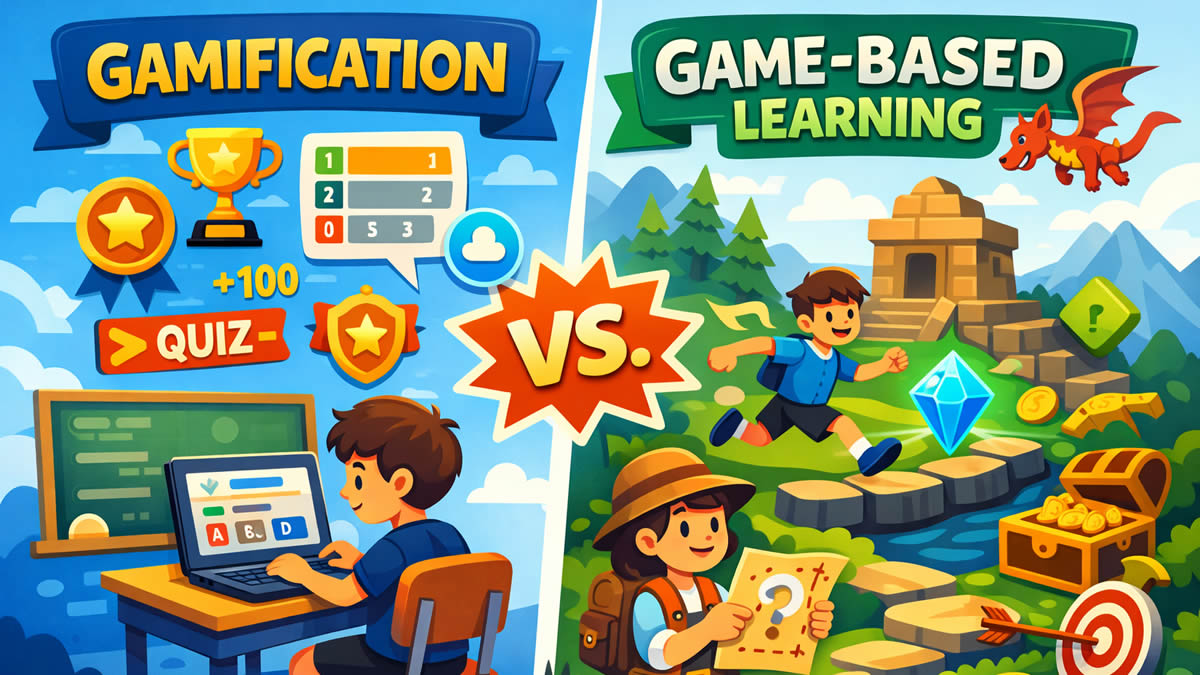
Gamification is the use of game design elements (points, badges, levels, leaderboards, streaks) in a non-game activity.
Source: Deterding et al. (2011) definition of gamification (ACM)
Game-based learning (GBL) is when the learning happens through playing a game—where the game mechanics, decisions, feedback, and progression are part of the learning experience (not just decoration on top of a quiz).
Source: Gamification vs. game-based learning (University of Waterloo) and Game-based learning overview (University of Illinois CITL)
Why the confusion? Because in classrooms, many “game” tools are actually quiz-first experiences with a game wrapper. They’re useful—just often mislabeled.
A practical way to remember it:
- Gamification = “We added game elements to learning.”
- Game-based learning = “We designed learning as a game experience.”
Why the difference matters: engagement vs. learning
Gamification can boost motivation—especially short-term. But game-based learning can change how students think, practice, and remember because it can support learning mechanisms like:
1) More retrieval practice, less recognition
Many gamified activities lean heavily on recognition (“pick A/B/C/D quickly”). Retrieval practice is different: learners have to pull information from memory, which strengthens long-term retention (the “testing effect”).
Source: Roediger & Karpicke (2006) on test-enhanced learning
Well-designed games naturally create repeated opportunities to retrieve:
- recall under mild pressure
- apply knowledge to progress
- try again with feedback
2) Immediate feedback that shapes understanding
Feedback is a learning engine. If students get fast feedback in context (“that choice didn’t work—try a different strategy”), they adjust mental models in real time.
That’s different from “right/wrong” after a quiz question—helpful, but often disconnected from a meaningful decision.
Source: Hattie & Timperley (2007), The Power of Feedback
3) Intrinsic motivation (when the game is the point)
Gamification often relies on extrinsic motivators (points, prizes). Game-based learning can tap intrinsic motivation—curiosity, autonomy, challenge, mastery—especially when learners feel choice and competence.
Source: Ryan & Deci (2000) on Self-Determination Theory (PDF)
That doesn’t mean points are “bad.” It means the source of motivation changes:
- Points motivate “finish this task.”
- Play motivates “I want to keep going.”
4) Better transfer when practice feels like problem-solving
High-quality educational games tend to ask learners to make decisions, test hypotheses, and adapt—skills tied to transfer and deeper understanding.
Research reviews and meta-analyses generally find that serious games can improve learning outcomes compared to more conventional instruction, though impact depends heavily on design and implementation.
Sources: Wouters et al. (2013) serious games meta-analysis, Clark et al. (2016) digital games meta-analysis
A quick classroom comparison
Let’s compare two common review-day setups.
Scenario A: A points-based quiz (gamification)
- Students answer 20 multiple-choice questions
- Speed + correctness = points
- Leaderboard drives competition
- Teacher gets a score report
Strengths
- Fast to run
- High participation
- Good for quick checks
Limitations
- Often rewards speed over thinking
- Less decision-making or exploration
- Can turn into “guess fast” behavior
- Learning may plateau if the activity stays the same format every time
Note: Leaderboards can motivate some learners, but research finds mixed effects depending on design and context. If you use them, consider options like team leaderboards, private progress, or “personal best” goals.
Source: Leaderboard effectiveness study (Computers & Education, 2024)
Scenario B: A game experience built around the same content (game-based learning)
Using BrainFusion as an example, you can take that same question set and play it in multiple modes—like an exploration-based format (Artifact Adventure) or an arcade loop (Ninja Fruit Frenzy)—where questions are tied to progress, movement, and goals.
Strengths
- Same content, different cognitive experience (“create once, play many ways”)
- Variety reduces “format fatigue”
- The game loop encourages persistence and repeated practice
- Question-level analytics help you reteach precisely
Tradeoffs
- Requires choosing a mode that matches the learning goal (more on that below)
- Still needs smart question design (the game doesn’t fix unclear prompts)
When gamification is enough (and when it isn’t)
Gamification is a great fit when your goal is:
- Routine practice (vocab, facts, quick fluency)
- Participation boosts (students who need a nudge to start)
- Short formative checks (quick signal: “What do we need to reteach?”)
Source: Formative vs. summative assessments (Yale Poorvu Center) - Momentum (“Let’s get reps in quickly”)
But if you want:
- deeper conceptual understanding
- stronger retention over time
- application and transfer
- meaningful collaboration or strategy
…you’ll usually get more leverage from game-based learning (or a hybrid approach).
What “true” game-based learning includes
Not every game is good for learning—and not every “educational game” is actually game-based learning.
Look for these ingredients:
1) Learning objectives are embedded in play
The learning isn’t a pause between fun moments.
It’s part of what makes you succeed.
2) Decisions matter
Learners choose paths, strategies, or actions—and those choices affect outcomes.
3) Feedback is immediate and usable
Good game feedback helps players improve, not just feel judged.
Source: Hattie & Timperley (2007)
4) Progress reflects mastery (not just time-on-task)
Levels, unlocks, and achievements should represent meaningful learning progress.
5) Low-stakes repetition is built in
Games make “try again” feel natural, which supports repeated retrieval practice.
Source: Roediger & Karpicke (2006)
💡 Pro Tip: Match the “game loop” to the learning goal
Use fast loops (short questions + quick feedback) for fluency and retrieval. Use slower, exploration or scenario loops when you want reasoning, discussion, and transfer.
A simple checklist: are you gamifying… or using game-based learning?
Use this quick diagnostic:
If most of these are true, you’re likely doing gamification:
- Points/leaderboards are the main “game” layer
- The activity is still a quiz, worksheet, or lecture at its core
- Students could do the exact same task without losing much learning value
- Success is mostly speed + accuracy
If most of these are true, you’re likely doing game-based learning:
- Students learn by playing, not by “earning points for doing work”
- The game’s decisions/feedback drive learning forward
- The activity has goals, constraints, and meaningful progression
- Students want to replay because the experience is compelling
Common mistakes (and how to avoid them)
Best Practices
- Start with a clear learning target (what must students be able to do?)
- Use questions/prompts that demand thinking, not just recognition
- Build in repetition across days (spaced practice beats cramming)
- Review question-level misses to target reteach and small groups
Helpful research anchors:
- Retrieval practice: Roediger & Karpicke (2006)
- Feedback: Hattie & Timperley (2007)
Common Mistakes to Avoid
- ❌ Using points to “mask” boring practice without changing the learning task
- ❌ Over-rewarding speed (especially for novices)
- ❌ Treating engagement as proof of mastery
- ❌ Running the same game format so often that novelty wears off
- ❌ Skipping reflection (“What strategy helped you win? What did you learn?”)
⚠️ Watch-out: “Fun” can become noise
If game elements distract from the learning target (or encourage guessing), engagement rises but retention may not. Tight alignment beats flashy effects.
How BrainFusion supports the “richer” approach
BrainFusion is designed around learning science principles (retrieval practice, immediate feedback, and spaced repetition) and uses multiple game modes so you can keep practice fresh without rebuilding content.
In practice, that means you can:
- generate or import a question set quickly
- play it live in different modes (instead of repeating the same quiz loop)
- run low-friction sessions (students join with a simple code—no student accounts)
- review question-level analytics to plan reteach and interventions
If you’ve been using “gamified quizzes,” the easiest upgrade path is not abandoning them—it’s expanding them into a game-based learning rotation:
- Monday: warmup
- Wednesday: an exploratory mode for application
- Friday: arcade-style review for fluency + confidence
Next steps: choose one upgrade you can try this week
If you want to move from “points on top” to “learning through play,” pick one:
- Add meaningful choices (branching questions, “best next step” items)
- Shift from speed to mastery (time windows, retries, reflection moments)
- Rotate formats so students don’t burn out on the same quiz experience
- Use analytics to target tomorrow’s reteach instead of reteaching everything
When game mechanics and learning objectives pull in the same direction, you don’t just get engagement—you get results that last.
Turn your next review into real play
Create a game from your lesson in minutes and run a live session with your class—no student accounts required.